
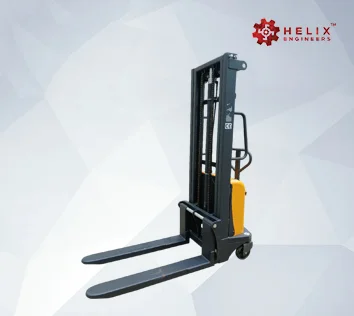
Electric Stacker
The Electric Stacker (Fully Powered Pallet Stacker) is a material handling solution that makes stack operations more efficient, automates the travel drive and vertical fork elevation. Operated by sophisticated electric drive motors and powerful battery packs, it dispenses with manual pushing and pumping, allowing an operator to easily and efficiently lift, carry and load heavy palletized loads over short, narrow aisles in the warehouse and on production floors.
Purpose and Application
Electric Stackers are specially designed for short to medium distance material handling and high frequency pallet stacking. They fully automate the movement of loads, giving maximum throughput, avoiding operator physical tiredness and ensuring safety in high-density rack storage.
Key Applications:
- High-Bay Rack Stacking:Lifts and places heavy pallets loads safely into multi-level pallet racking.
- Intensive Dock Operations:Loads and unloads delivery trucks, trailers and shipping containers quickly.
- Warehouse Order Distribution:Used as a major transport vehicle for transporting goods from staging to storage bays.
- Manufacturing Line Replenishment:Provides large bins of raw materials and components to assembly stations as needed.
Design and
Operation
- Rigid Mast & Carriage:Built of heavy gauge C channel steel with built in anti-roll bearings for high elevation lifting, exceptional torsional rigidity.
- Multi-Function Tiller Handle:Thumb-controlled proportional speed controls, lift/lower push buttons, horn, emergency reverse belly button and turtle-speed switch are all within thumb reach.
- Advanced AC Drive System:Brushless AC motor – Acceleration is smooth, high torque in inclines, no maintenance as it has regenerative braking during reduction of speed.
- Comprehensive Safety Suite:Comprehensive Safety Suite includes a transparent Plexiglas/mesh safety shield on the mast, automatic speed reduction at corners and electromagnetic parking brakes that automatically engage on inclines and declines.
Production & Quality Assurance
- Precision CNC Fabrication:Precision laser cutting and robot welding ensures the exactness of structural alignment and stability under load for mast channels, chassis frames, straddle legs etc.
- Shot-Blasting & Powder Coating:Prior to the application of the electrostatic powder coat finish, all of the steel structures are shot-blasted to remove scale, and then given an electrostatic powder coat finish for maximum protection against chipping and corrosion.
- Electrical & Drive Assembly:Controller modules (CURTIS/ZAPI), wiring harnesses, hydraulic pumps and drive motors are mounted in a dust controlled assembly line and passed moisture/dust testing to IP rating.
- 125% Load & Dynamic Testing:All units are factory loaded to 125% of load and tested for carriage stability through full height and anti-rollback on slopes, dynamic braking distance, and continuous testing before being dispatched from the factory.
Conclusion
An electric stacker helps warehouses and manufacturing units handle palletized goods with less manual effort. Its powered lifting and travel functions make it easier to move materials, stack pallets on racks, and support regular loading and unloading operations. Features such as a rigid mast, responsive controls, and built-in safety systems help support stable operation. Before choosing an electric stacker, it is important to consider load capacity, lifting height, aisle width, battery performance, and the type of material handling work involved.
Frequently Asked Questions
What is an electric stacker used for?
An electric stacker is used to lift, move, and stack palletized goods in warehouses, storage areas, and manufacturing units.
What should be considered when choosing an electric stacker?
Load capacity, lifting height, aisle space, battery performance, and daily operating requirements should be considered.
How does an electric stacker reduce manual effort?
Its electric drive and powered lifting system reduce the need for manual pushing and pumping during material handling operations.