
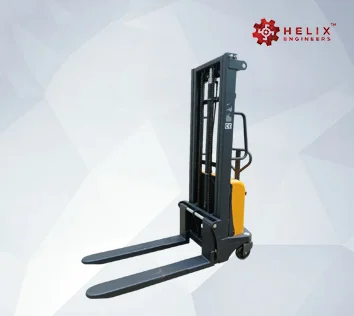
Semi Electric Stacker
The Semi-Electric Stacker offers a cost-effective hybrid material handling solution, combining powered electric lifting with manual pushing and steering. Designed to eliminate the physical exertion of hand-pumping heavy loads, it delivers fast, effortless vertical lifting while maintaining the agility and tight turning radius of a manual stacker—making it ideal for small-to-medium warehouses and light industrial bays.
Purpose and Application
Semi-Electric Stackers bridge the gap between manual hand stackers and fully motorized units. They excel in applications where lifting frequency is high, but travel distances between work stations remain relatively short.
Key Applications:
- Light to Medium Stacking:Effortlessly elevates palletized goods into lower and mid-tier racking systems.
- Vehicle Loading & Unloading:Speeds up loading and unloading operations on delivery trucks, vans, and tailgates without dedicated dock levellers.
- Workstation Elevation:Functions as an adjustable-height work platform to hold parts at an ergonomic waist level for operators.
- Tight-Aisle Warehousing:Navigates confined storage areas and narrow aisles where fully powered electric stackers are too heavy or wide to maneuver.
Design and
Operation
- Rigid C-Channel Steel Mast:Built from heavy-duty structural C-section steel with precision mast rollers to prevent frame twist during high-elevation lifts.
- Electro-Hydraulic Power Unit:A high-torque DC motor powers a compact hydraulic pump, controlled via an intuitive push-button switch or hydraulic lever for smooth, rapid elevation.
- Ergonomic Steering Handle:A rubberized loop handle with a spring-return mechanism enables low-effort steering and maneuvering across smooth floor surfaces.
- Safety Integration:Features a transparent Plexiglas or mesh protective mast screen, an emergency power cut-off button, an overload safety bypass valve, and heavy-duty foot guards over the rear casters.
Production & Quality Assurance
Precision Laser Fabrication: Mast profiles, straddle legs, and fork carriages are CNC laser-cut and robotically welded for tight tolerances and long-term structural integrity.
Shot-Blasting & Powder Coating: Metal components undergo automatic shot-blasting to remove mill scale, followed by an electrostatically applied powder coat for scratch and corrosion resistance.
Hydraulic & Electrical Assembly: Hydraulic pumps, cylinders, battery wiring, and built-in chargers are assembled in clean bays and tested for zero-leak performance.
Load & Elevation Testing: Every unit undergoes a $125\%$ static load test, full-height carriage stability verification, and continuous cycle testing prior to final dispatch.
Conclusion
A semi-electric stacker is a practical option for warehouses and small industrial units that need powered lifting without the cost of a fully electric stacker. Its electric lifting system reduces manual effort, while manual movement allows operators to handle materials across short distances. Features such as a strong steel mast, safety controls, and a reliable hydraulic system support daily stacking and loading work. Before selecting a semi-electric stacker, consider the load capacity, lifting height, aisle space, and frequency of use.
Frequently Asked Questions
What is a semi-electric stacker used for?
A semi-electric stacker is used to lift and stack palletized goods, load and unload vehicles, and move materials over short distances.
How does a semi-electric stacker work?
It uses an electric motor for lifting and lowering loads, while the operator manually pushes and steers the equipment.
What should be considered when choosing a semi-electric stacker?
Load capacity, lifting height, fork dimensions, available space, and daily usage requirements should be considered.