
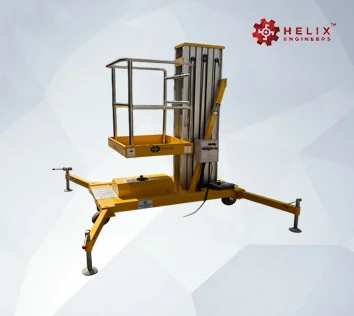
Aerial Work Platform
An Aerial Work Platform (AWP), also known as an elevated work platform or mobile elevating work platform (MEWP), is a mechanical access device engineered to safely elevate personnel, tools, and materials to high-altitude working areas. Serving as a secure alternative to traditional scaffolding and ladders, this equipment provides stable, enclosed platform access for construction, installation, and industrial maintenance operations.
Available in vertical mast, scissor lift, and articulating boom configurations, the Aerial Work Platform features electro-hydraulic elevation systems, robust outrigger stabilization, and dual ground/platform control consoles, ensuring precise positioning and uncompromising safety compliance at elevated heights.
Purpose and Application
The Aerial Work Platform streamlines overhead installation and maintenance tasks by providing rapid vertical access, eliminating long assembly setup times associated with conventional scaffolding.
Key Applications:
- Facility & Building Maintenance:Execute high-level lighting repairs, HVAC duct servicing, pipework installation, and structural cleaning in factories and commercial spaces.
- Warehouse & Logistics Management:Perform inventory audits, overhead sprinkler inspections, and high-rack maintenance across distribution centers.
- Construction & Architectural Works:Facilitate ceiling installations, wall panel mounting, electrical wiring, and painting on commercial job sites.
- Event & Media Infrastructure:Mount overhead lighting rigs, audiovisual systems, and banner displays in convention centers, arenas, and auditoriums.
Design and
Operation
Structural & Safety Features
- Dual Control Consoles:Features proportional control stations on both the upper basket platform and the ground chassis, allowing operators to control elevation from above or below.
- Interlocked Safety Outriggers:Electric interlocks prevent platform elevation unless all outriggers are fully deployed and ground pressure indicators register a level base.
- Fall Protection Guardrails:Fully enclosed steel or high-tensile aluminum guardrails with self-locking entry gates and integrated kick-plates to prevent tool drop hazards.
- Emergency Descent System:Manual hydraulic release valve enables safe platform descent from ground level in the event of power interruption or battery depletion.
Operational Workflow
- Pre-Operation Inspection & Positioning:Position the machine on a stable surface, turn on power, and verify battery charge levels and emergency stop buttons.
- Outrigger Deployment:Extend outriggers fully and adjust level jacks until the chassis bubble level indicates a zero-degree tilt and safety interlock LEDs illuminate green.
- Personnel Entry & Harness Securing:Step into the basket, lock the entry gate, and attach harness lanyards to designated anchor points on the platform frame.
- Elevation & Positioning:Use the proportional joystick or toggle switch on the upper control panel to elevate to the required working height; release controls to engage automatic hydraulic hold brakes.
Production & Quality Standards
- Precision Structural Fabrication:Constructed using CNC laser-cut structural steel tubing and high-strength extruded aluminum masts, joined via continuous robotic seam welding for frame rigidity.
- Precision Electro-Hydraulics:Fitted with hard-chrome plated cylinder rams, micro-honed hydraulic barrels, and pressure-compensated control valves for chatter-free elevation and descent.
- 125% Factory Proof Load Testing:Every unit undergoes static and dynamic overload testing at 125% of rated platform capacity, including tilt-break checks and emergency descent validation.
- International Safety Compliance:Designed and manufactured in full accordance with recognized international access standards, including EN 280, ANSI/SAIA A92.20, and CE machinery safety regulations.
Conclusion
An Aerial Work Platform provides safe and convenient access to elevated areas for maintenance, installation, construction, and warehouse operations. Its lifting mechanism allows workers to reach overhead work areas while carrying the necessary tools and equipment. Features such as guardrails, dual control consoles, safety interlocks, and emergency descent systems support controlled operation at height. Before selecting an Aerial Work Platform, consider the required working height, platform capacity, available space, ground conditions, and safety features.
Frequently Asked Questions
What is an Aerial Work Platform used for?
An Aerial Work Platform is used to raise workers, tools, and equipment for tasks such as electrical repairs, ceiling installation, painting, and warehouse maintenance.
What are the different types of Aerial Work Platforms?
Common types include vertical mast platforms, scissor lifts, and articulating boom lifts. The suitable type depends on the working height, access requirements, and site conditions.
What safety features should an Aerial Work Platform have?
Important safety features include guardrails, secure entry gates, emergency stop controls, emergency descent systems, and suitable stabilization mechanisms.